Showing posts with label Lessons from the Masters. Show all posts

June 17, 2016

Imitating Sam Abell Composition Techniques…with my phone camera!

I read an amusing article awhile ago about the stages every photographer goes through. One of the stages mentioned was studying the work of other great photographers (the ones who have stood the test of time) and building a photo book collection. I’m there. I’m collecting the books. I’m reading and being inspired by the books, by the photographers. I’m combing the internets and finding neato lectures by the amazing photographers. And then I’m blogging what I’m learning – most recently I’ve done this with the work of Sam Abell .

This morning, as my husband and I were enjoying the low-tide, wider-than-usual beach, I decided to experiment with creating an image explicitly inspired by Sam Abell’s style and the compositional choices he often makes to define his own imagery. I had only my phone with me, so this was strictly an exercise in composition and not in camera settings. To quickly summarize, Abell emphasizes the following: Composing from “the back” (the horizon, the environment, the geography), inhabiting “the front”, heads & shoulders belong above the horizon, and students quip that “nothing touches”. More description and links to Abell’s teaching can be found in this blog post referenced above.

So here are the results from my morning’s experiment …

1.  Compose from the back.  Find/create your environment/horizon.

1

2.  Anticipate what will happen (my husband will climb on a rock; he always climbs on a rock).

2

3.  “Inhabit the front”. (I’m thinking about rock/sand detail and how best to showcase that).

3

4.  Remember that ideally Sam Abell likes to place people above the horizon. He also likes low angles and “looking through surfaces”. (in the above picture, Big Dude is above the ocean line horizon, but not above the mountain horizon … I need to figure out which is my main background horizon. I also decide that I want my foreground to be stronger, more dramatic, more like “looking thru a surface”.)

4

5.  Lastly, I decide to use my strong foreground “look thru rock surface” to block out the homes on the left.

5

6.  In the end, I think I probably prefer the 4th image that includes the homes as leading lines.


May 26, 2016

Lessons from the Masters: the flowers of Georgia O’Keeffe

I have always been arrested by the work of Georgia O’Keeffe.  And macro flower photography has long had soft spot in my heart.  Surely the two are related?

o'keeffe

"A flower is relatively small. Everyone has many associations with a flower - the idea of flowers. You put out your hand to touch the flower - lean forward to smell it - maybe touch it with your lips almost without thinking - or give it to someone to please them. Still - in a way - nobody sees a flower - really - it is so small - we haven't time - and to see takes time like to have a friend takes time. If I could paint the flower exactly as I see it no one would see what I see because I would paint it small like the flower is small.
So I said to myself - I'll paint what I see - what the flower is to me but I'll paint it big and they will be surprised into taking time to look at it. "  Georgia O'Keeffe, "About Myself," 1939

IMG_7685
“Sometimes I start in a very realistic fashion, and as I go on from one painting to another of the same kind, it becomes simplified until it can be nothing but abstraction.”

IMG_7131
To William M. Milliken (Director, Cleveland Art Museum), 1 November 1930:
"Dear Mr.Miliken: I have been hoping that you would forget that you asked me to write you of the White Flower, but I see that you do not.

It is easier for me to paint it than to write about it and I would so much rather people would look at it than read about it. I see no reason for painting anything that can be put into any other form as well.

At the time I made this painting - outside my door that opened on a wide stretch of desert these flowers bloomed all summer in the daytime.

The large White Flower with the golden heart is something I have to say about White - quite different from what White has been meaning to me. Whether the flower or the color is the focus I do not know. I do know that this flower is painted large to convey to you my experience of the flower and what is my experience of the flower if it is not color.      I know I can not paint a flower. I can not paint the sun on the desert on a bright summer morning but maybe in terms of paint color I can convey to you my experience of the flower or the experience that makes the flower of significance to me at that particular time.

Color is one of the great things in the world that makes life worth living to me and as I have come to think of painting it is my efforts to create an equivalent with paint color for the world, life as I see it.

Yours very truly,
Georgia O'Keeffe."

IMG_8044

“I often painted fragments of things, because it seemed to make my statement as well as or better than the whole could.”

IMG_9669

When you take a flower in your hand and really look at it, it's your world for the moment. I want to give that world to someone else. Most people in the city rush around so, they have no time to look at a flower. I want them to see it whether they want to or not. ”

IMG_8103

List of Characteristics of her flower paintings (as compiled on about.com):

  • O'Keeffe loved the forms and shapes of nature. She would walk miles in the desert sun of New Mexico, collecting rocks and sun-bleached bones.  
  • Many of the forms she paints are pared down, simplified to essential shapes and forms,  sculptural, with gently rounded corners.
  • Lines in her paintings and drawings are curvy and sinuous, like a winding river.
  • O'Keeffe created a unique fusion of realism and abstraction. Although she worked from identifiable subject matter, she abstracted it in her own way.
  • She was interested in scale and experimenting with it.  She painted flowers much larger than life so that people would take notice and experience them the same way she did. Some of her paintings show foreground objects in grand scale, making them appear monumental, while mountains in the distance are diminutive, such as in her paintings of bones against a desert sky.
  • She used photography techniques like zooming and cropping. She magnified the flowers and cropped them, zooming in on them and filling the canvas, using a technique introduced by photography. By continuing to zoom in and crop her subject she created increasingly abstract compositions.
  • O'Keeffe loved bright, bold and intense color. She would often use bright blues, yellows, greens, reds, and purples.
  • She often painted using flat color, emphasizing the shape of her subject rather than three-dimensional form.  Her paintings convey an even lighting, as though everything is painted at high noon.

Nifty biopic film here at the okeeffemuseum.org.  Includes film & photographs of the landscapes she translated into paintings/drawings.  Includes film and photography of O’Keeffe herself, as well as recorded interviews with her and readings from her letters. 

IMG_8068IMG_8097IMG_9784IMG_7668T

April 16, 2016

To View–or Not to View–the Work of Other Creatives

Original Creation, Study the Masters, Imitation is the Highest Compliment, Imitation is Plagiarism, Copying is Bad, Nothing is Original, Be Original, Don’t Look, LOOK!!   I’ve heard it all.  And often.  And I think there are gems of wisdom throughout the “Photographic Celibacy” (a phrase coined by Cole Thompson that advocates never studying your fellow photographers’ work) Continuum (the “Continuum” is my mashup of the varying philosophies).  To View or Not To View.  Here are the options as I see them through these five articles…

Complete Celibacy:  Cole Thompson*, if it’s important to you to develop your own individual vision, it’s perhaps worth considering NOT viewing/studying/”being-inspired-by” other photographers’ work.  Studying others’ work can make an “imprint” on your conscious and subconscious mind and end up in your own creations.  I appreciated this quote by Cole Thompson:  [at a portfolio review of his own work] “One of the reviewers said that it appeared I was trying to copy Ansel Adams and Edward Weston’s style.  When I responded that I was, because I loved their work, he very bluntly pointed out that Ansel already did Ansel and that no one was going to do it better than Ansel.”

Modified Celibacy:  Sarah Marino*, it’s ok to look and find inspiration, but it matters *when* you choose to look and *when* you choose to avoid.  Sarah Marino’s approach [to her landscape photography]:  “While I still find energy and inspiration in viewing photographs from others, I try to be diligent about not researching a place I am going to visit or am already photographing. By avoiding researching how others have photographed a place, I am able to approach it with awe, wonder, and curiosity rather than spending mental energy trying to keep outside influences at bay.”

Helsinki Bus Station Theory (this is a fantastic analogy, be sure to click thru!) - Arno Rafael Minkkinen*, developing your own creative vision is a journey and you should  “STAY ON THE BUS” to differentiate your work, create your masterpieces, have the “stamp of your unique vision.”

Explore Others’ Work to Extend & Define Our Own - Erin Babnik*, it’s ok standing on the shoulders of giants, just make sure you are contributing and “extending the conversation”, creating *substance* more so than *difference*.  This quote from Erin that I LOVE:  “… burying your head in the sand only cuts off an important avenue for personal development. If we think about existing photographs positively, as foundational elements for all that follows, then we will be more likely to process this visual input in creative ways. We don’t have to try to ‘un-see’ other photographs or fear how they might affect our own work if we embrace the idea that we can ‘own’ our responses to them.”

Binge/Spree/Debauchery(only said here as an antonym of celibacy):  Ugo Cei*, no artist grows in a vacuum, study, immerse yourself, devour, select only inspiration that speaks to your soul and lights a fire, be deliberate, practice and practice and practice more, feed your muse.  Ugo Cei has a great list of “to do” activities that help you do just that.
*each article referred to above is linked; just click on name.

So where do I fall in this spectrum?  Truthfully, at different times I land in different places.  In the beginning, I was all about studying peers I admired.  I’ve gone through periods where I minutely study only my own work and look for the common threads of what makes “my” pictures mine.  I look for my weaknesses.  I look for my strengths.  I then look again at strengths of peers’ work.  More importantly, I study what makes the Masters masters.  I’m all about the Copia.

erasmus de copia

Copia is a term of rhetoric that refers to expansive richness and amplification as a stylistic goal; it’s loosely translated from Latin to mean an abundant and ready supply of language – something appropriate to say or write whenever the occasion arises.  Erasmus created a whole theory and wrote an entire book on this concept.   Please forgive my segue here; I promise to tie it all together …My dudes (God bless ‘em) have all been exposed, from the very first days of their education, to writing by imitation.  I did not set them up with a notebook and tell them to freeform diary their thoughts.  Instead, I gave them beautiful sentences to copy.  We studied Aesop’s fables and timeless fairytales and worked our way up to classics of literature and famous essays.  My dudes studied and imitated and paraphrased these masters of writing and rhetoric.  We developed COPIA:  figures of description, figures of speech, simple/compound/complex/compound-complex sentence structure, expansion, contraction, types of paragraphs for essays (encomium, paraphrase, cause, opposite, analogy, examples, testimony, epilogue, confirmation, refutation, comparison).  We played with narrative structures – simple linear, flashbacks, in medias res, end-to-beginning.  All of these pieces of the rhetoric puzzle are “tools in our toolbox” to help us write persuasively and beautifully.  And if Little Dude asks me even one more time WHY he has to incorporate three figures of speech into his narrative … (but I digress…)  Anywhooo.  COPIA.  Tools in my toolbox.  I like to study the excellent elements of excellent artists.  If there’s room to incorporate such excellence into my own creations, I’m all for it.  I want a whole "toolbox" of elements of excellence that I can choose to use or exclude in the making of my images.  And thus, Erasmus, a writer/rhetorician makes it into my post category of "Lessons from the Masters."

And in the spirit of celebrating the development of copia … here is Little Dude in his graphite drawing class, learning from a master, imitating art, all with the goal of stretching/refining/defining his own skills and vision.
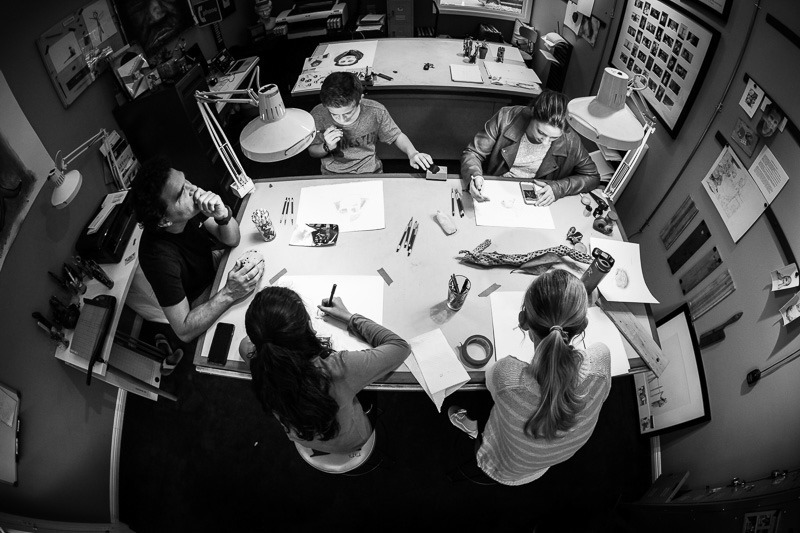
imitation as a path to creation

March 24, 2016

Lessons from the Masters: Helen Levitt


helen levitt2

How delightful and humorous is this image captured by New York street photographer Helen Levitt? I love what her friend James Agee wrote about her and her photographic style ...

"In every other art which draws directly on the actual world, the actual is transformed by the artist's creative intelligence, into a new and different kind of reality: aesthetic reality. In the kind of photography we are talking about here, the actual is not at all transformed; it is reflected and recorded, within the limits of the camera, with all possible accuracy. The artist's task is not to alter the world as the eye sees it into a world of aesthetic reality, but to perceive the aesthetic reality within the actual world, and to make an undisturbed and faithful record of the instant in which this movement of creativeness achieves its most expressive crystallization."

Not altering reality to bring aesthetic to it. But actually, truly, seeing & perceiving the aesthetic beauty within the world just as it is. Hands down, this is my heart's desire for every session I'm commissioned for and for my documentation of my own family.

March 17, 2016

Lessons from the Masters: Sam Abell

This book + this fabulous 2 hour lecture = GOLD.  Insightful, interesting stories about the creation (creative process) of images.  Sam Abell tells a good story.  And debunks a good many myths.  And learning about his process inspires me to be more intentional about my own process.  


Some notes from his lecture ...

re: Train photo, taken at age 14. Submitted to canon contest. Wanted to win whole shebang.  Instead won $15 honorable mention prize in junior category.  Only printed – in his basement darkroom, which was only truly dark at nighttime – 3 copies.  Just sold last print. 

Shoots full-frame [digital now] only, full uncropped image, aims for sooc-uncropped, just as he did when shooting analog.  Inspired by, of course, Henri Cartier Bresson.   Likes to shoot with two bodies, 1 with a 28mm lens, 1 with 90mm = his walkaround “kit”.  Uses 90% of time.  Shoots without flash.  Sometimes with tripod, usually without.

[Now iconic] Train picture of his dad – Dad gave him his rolleicord camera, told him to compose the picture and wait.  Recommended low angle, leading lines.  His dad also told him “bad weather makes good pictures.”  :-D

His dad taught him how to photograph.  His mom taught him what to photograph.

Composing from “the back” (the horizon, the environment, the geography), inhabiting “the front”, heads & shoulders belong above the horizon.  Student in Abell’s class summarizing main point [humorously]:  “nothing touches”.   (the “articulation of space”)

3’, 4’, 5’ of height makes everything look better (being able to get above your scene/subject)

Macro composition (all that’s in your frame, edge to edge, the whole enchilada) vs. micro composition (the specific articulation of space, compose & wait, NOTHING TOUCHES – ha!)

One of Abell’s defining features … a strong horizon line.  (ie in his window/kremlin photo, dropping out the kremlin background by rising higher, thus catching cement sill of building=strong dividing horizon line, and finally ending with strong window frame line as horizon, and bringing waving-in-the-wind curtain back in.   took 12 hours to create final image)

OMGosh!!!  Sam Abell shoots Canon full-frame in “P” mode with +/- wheel.  Uses lcd on back to determine if he’s happy with image AS IS (no plans to photoshop).  He then laughs and says Canon doesn’t want him to tell people this.

Internal framing goal:  linking still life to landscape

Compose (the “macro” part:  looking edge to edge, whole setting, back to front, separation of layers,  internal framing?, looking thru surfaces?). Wait. (for a blue umbrella, a dog & Frisbee, a bison, wind on albino peacock feathers, a horse whinnying …).  Adjust (the “micro” part: a gesture, expression, lining everything up, and as one student summarized: NOTHING TOUCHES).   Shooting on “P”.  Not cropping.  Not using Photoshop.  Sam calls this a church of photography – one where very, very few people are in the pews, and he’s afraid to turn around and look lest he finds he’s the only one in the pews.

*****
Not from the book or lecture, but a recent shift in focus....
His epiphany, resulting in his current project:  http://distinctionhr.com/2014/02/sam-abell/